Jha introduces the “question ladder,” a five-level framework ranging from simple information retrieval to transformational questioning that challenges existing paradigms. Using a case study of the Ford F-150, she demonstrates how reframing a product brief from mechanical improvements to understanding user lifestyle needs can lead to significant design innovations. The session concludes with practical advice for leaders on fostering a culture of curiosity and using “question storming” to drive strategic breakthroughs.
An innovation strategist, Jha has led innovation teams and executive education for organizations like Ford, Cisco, and Harvard. Her work explores a central question: How do we expand human capacity to think, create, and make better decisions in an age of expanding intelligence?
Prapti Jha (In Her Own Words):
I’d love to present a new point of view on the work you’re doing within the expanding intelligence ecosystem we’re navigating today.
The Power of a Child’s Question
In 1943, four-year-old Jennifer asked her father as he took her photo, “Daddy, why can’t I see the picture right away?” That simple question led to the invention of the Polaroid camera. Her father was Edwin Land.
Children ask countless questions. As adults, we ask almost none—at least not genuine, curious ones. We’ve traded curiosity for operational efficiency, and it costs us creativity, innovation, and growth.
My first challenge: start asking more questions. Ask the ones that make you feel slightly embarrassed. Embrace a questioning mindset—it’s a game changer.
Differentiating Your Thinking
Teams that break through aren’t the ones with the most information—they’re the ones asking fundamentally different questions. In a world where execution is getting cheaper and faster, thinking becomes the differentiator. And questioning is the operating system for that thinking.
In the industrial age, advantage went to scale. In the knowledge era, it went to information access. Today, when AI makes answers essentially free, questions become the new scarcity. Yes, you can generate hundreds of questions instantly, but knowing which ones actually matter remains a human skill.
Generation Is Cheap. Selection Is the Job.
Start with question storming—generate volume, go wide, use AI to push you wider. But don’t stop there. If you just create a questions list, you’ve only done what machines excel at. The next step—determining which questions deserve your time, budget, and commitment—will stay human for a long time.
Here’s my most important message: in this era of expanding intelligence, generation is cheap. Selection is the job.
The Question Ladder: Five Levels of Inquiry
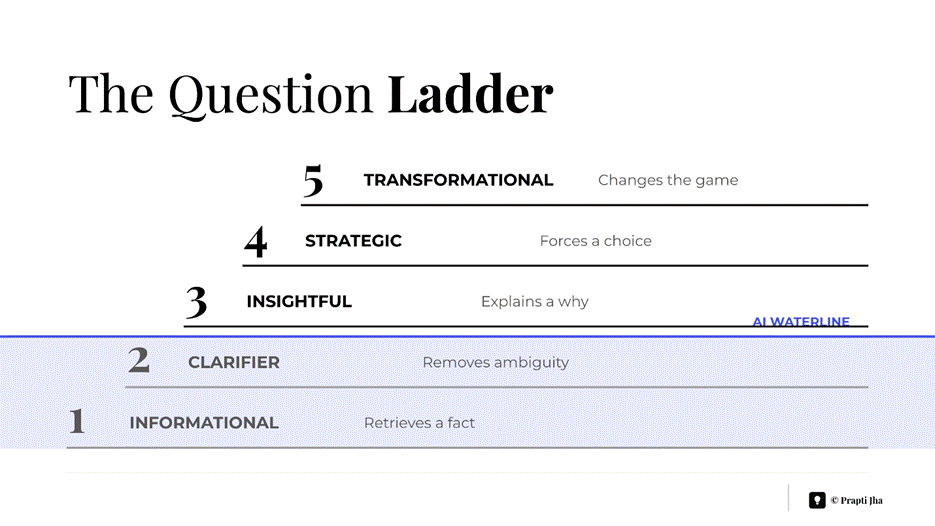
Every question sits on one of five levels. We need all five—this isn’t a ranking, it’s a map to see where you’re standing and whether that’s where the work needs you.
Level 1: Information — Retrieving facts. Now fully automated and being repriced against human labor.
Level 2: Clarification — Sharpening fuzzy questions into precise ones. Largely automated, sitting below the “AI waterline.”
Level 3: Insight — Asking “why.” AI spots patterns but cannot decide which explanation is true. That’s human judgment.
Level 4: Choice — Strategy. Forcing decisions between options. AI models trade-offs beautifully but has no stake in the outcome. That’s where human value lives.
Level 5: Transformation — Attacking the frame itself. Questioning what everyone agreed on and stopped questioning. This can be dangerous—it can make months of work look misguided—which is exactly why it’s the most valuable question today. Example: Instead of “Why isn’t adoption going up?” ask “Is adoption even the right measure of value?”
The Ford F-150 Case Study
When asked to “make the F-150 better,” teams typically suggest: more horsepower, cargo, towing capacity, fuel efficiency. These are level one answers AI can generate in seconds.
The team reframed: “How do people use their trucks today?” Through observation, they discovered drivers spend much of their lives in their trucks—as both working and living space.
The new question: How might we make the F-150 evolve to meet customers’ evolving needs and aspirations?
The breakthrough features: Seats that fall fully flat for rest between jobs. A storable gear shifter creating a flat workspace for laptops or lunch.
The reframe was the work. That’s what we as innovators must do.
AI Expands. You Select.
In innovation and research, we work across three phases: signals, insights, and bets. AI can scan more signals, generate more findings, and produce more options than we have appetite for.
But here’s what humans must bring:
At signals: relevance — Which signals actually matter? Filtering signal from noise.
At insights: assumptions — What would have to be true for this to hold? What are we assuming based on our context?
At bets: conviction — What’s actually at stake? Understanding organizational nuances that make the same bet function differently in different contexts.
Three Irreplaceable Human Layers
Context — What’s true for your organization that no model can access.
Judgment — Knowing which assumptions are load-bearing.
Ownership — Carrying consequences over time.
Skip relevance, get information overload. Skip assumptions, get average views everyone else would say. Skip conviction, make incremental changes instead of leap changes.
Next time AI hands you something, ask: “Is it expanding? Am I selecting? And if selecting, what am I selecting on?”
Let’s Talk Turkey
A mother chopped off turkey legs before roasting, placing them on top. Her daughter asked why. “That’s how my mom did it.” The grandmother said the same. Finally, the great-grandmother explained: “My oven was tiny—the whole turkey didn’t fit.”
How many turkey legs are we chopping off just because “that’s how it’s always been done”?
What will be your next transformational question?