Boards are pressing for “impact.” Teams are experimenting without permission. Vendors are promising transformations that sound suspiciously like alchemy. If you feel urgency bordering on dread, you’re not wrong.
AI is seeping into companies faster than any governance framework can keep up with. A junior analyst automates a reporting step. A marketer feeds sensitive text into a public model. A product manager wires a chatbot into a workflow “just to see what happens.” None of these are malicious. All of them are structural risks.
This moment doesn’t call for a grand AI manifesto so much as a renovation strategy. You aren’t building a new house. You’re updating the one you already live in… ideally without knocking out a load-bearing wall or discovering that someone has rewired a critical system with the confidence of a YouTube hobbyist.
This is your renovation playbook.
Your Role: Chief Building Inspector
Before you think about tools or pilots, you need clarity about your job in this story.
You are the Chief Building Inspector.
You decide what a “safe” AI upgrade looks like. You define which parts of the business must remain human. You set the conditions under which experimentation is encouraged and the places where it is absolutely not. You tell the organization which walls are merely decorative and which ones keep the roof from collapsing.
You are not installing the appliances. You are approving the wiring diagram.
That role matters, because without it, AI adoption starts to drift, one quiet change at a time.
Orchestrated vs. Rogue: How AI Enters a Company
If you imagine AI arrives through orderly strategy documents, that world does not exist. AI enters organizations much like water: through seams, through cracks, through enthusiastic employees who simply want to make something easier.
That creates the Shadow IT Spectrum:
- Orchestrated: Documented, intentional, reversible.
- Experimental: Local tests, mostly harmless, occasionally brilliant.
- Rogue: Tools no one vetted, changes no one tracked, risks no one meant to introduce.
Picture a well-meaning analyst at a Fortune 500 retailer pasting Q4 projections into ChatGPT to “clean up the formatting.” The data includes unannounced store closures. No malice. Very real risk.
The faster AI becomes, the faster companies slide toward the rogue end of the spectrum unless leadership steps in with guardrails. That’s why the inspector role comes first. Without boundaries, AI becomes a series of hidden renovations: surprising, uneven, and sometimes dangerously structural.
What Could Go Wrong (and How to Prevent It)
Failure Mode 1
A team member feeds proprietary customer data into a public model.
Prevention: A clear, enforced rule about where company data may live (and where it may not).
Failure Mode 2
A “helpful” automation bypasses a required review step.
Prevention: A published list of load-bearing workflows that may not be altered without approval.
Failure Mode 3
A pilot project becomes production because it “seems to work.”
Prevention: Reversibility requirements and documented acceptance criteria before anything goes live.
Executives don’t fear AI. They fear surprise. Remove the surprise.
The Anatomy of a Task (Unbundling the Bundle)
Once the boundaries are clear, the next step is to understand what’s inside the work.
Job titles are bundles, tidy names wrapped around messy collections of tasks. If you want to renovate effectively, you need to unbundle them into rooms.
When you enter a “room,” ask the simple, diagnostic questions that reveal the truth: What triggers this task? What comes into it… data, context, instructions? Critically, what decision or deliverable exits? Where does the frustration live? And where is tribal knowledge substituting for real process?
A Familiar Example: The Monthly Business Review
On an org chart, the Monthly Business Review looks like one task. In reality, it’s four rooms with very different architectures.
The Data Prep Closet is a cramped space full of manual reconciliation, file merging, and spreadsheet gymnastics: the kind of repetitive, rules-based drudgery no one will miss.
The Analysis Workshop is a room full of tools (many good, some questionable) where AI can accelerate thinking but shouldn’t replace it.
The Narrative Parlor is the room where meaning is made. Drafts are welcome; judgment is required.
And The Executive Presentation Theater is a load-bearing wall. You do not delegate the insight or the responsibility.
Understanding these rooms is what makes the renovation plan rational rather than reactive.
The Renovation Blueprint: Automate, Augment, Preserve
Renovation only makes sense when you know which room needs what.
Automate (Install New Appliances)
These are the repetitive, rules-based tasks with stable inputs and outputs. Updating them is as routine as replacing hand-washing with a dishwasher. No drama, just efficiency.
Augment (Add Better Tools)
Some tasks deserve power tools, not demolition. AI can accelerate analysis, propose options, and produce drafts, but you remain the craftsperson guiding the work.
Preserve (Protect the Load-Bearing Walls)
Some tasks must remain human: final interpretation, client communication, strategic judgment. These walls hold up the house. Remove them and the ceiling sags. Good judgment is still the moat and AI makes it more valuable, not less.
The Pilot Loop (A Repeatable Renovation Cycle)
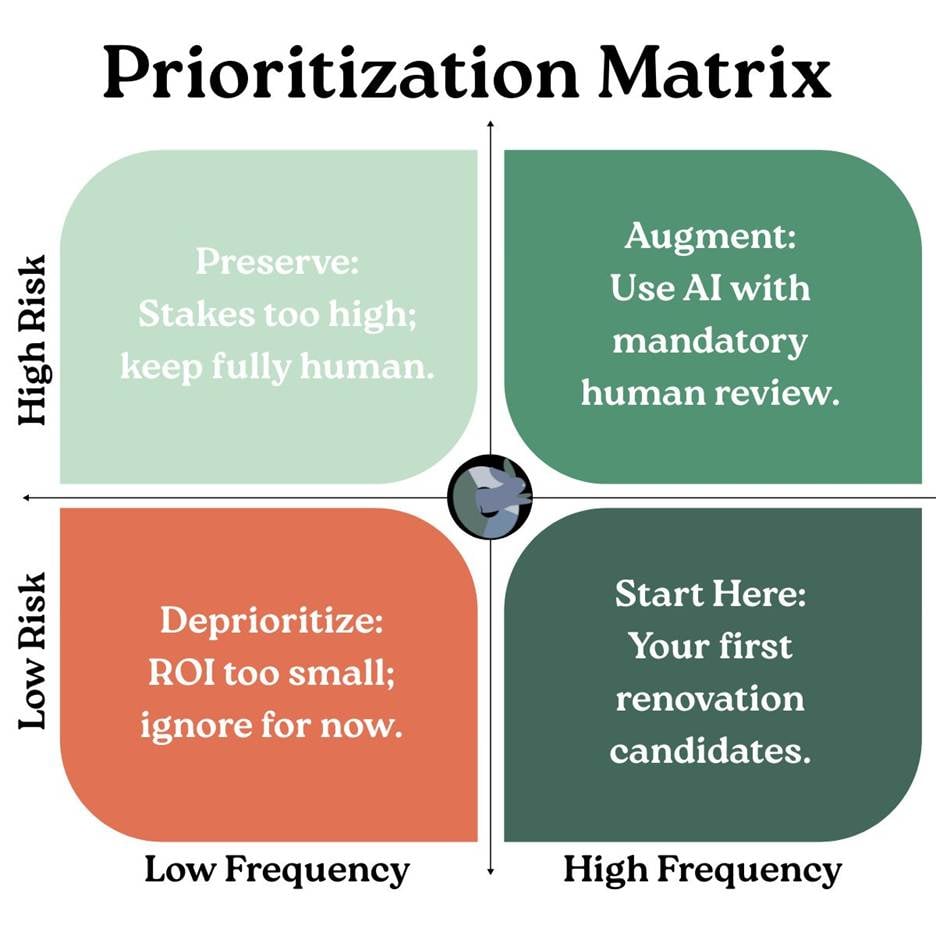
Once you’ve picked a candidate from the high-frequency, low-risk quadrant, you’re ready for the Pilot Loop. This is the cycle you run again and again until AI adoption becomes a normal rhythm rather than an anxiety-producing event.
Start with one workflow and:
- Walk the house: Observe the real work: the clicks, the copy-pastes, the “we’ve always done it this way” habits.
- Choose one room: Use the matrix; pick something reversible and low-risk.
- Prototype with what you already have: Use your existing AI-enabled tools. No procurement needed.
- Run with training wheels: Operate old and new processes in parallel. For example: run AI-generated weekly reports alongside human-generated ones for a month. Compare accuracy, tone, and stakeholder reactions before cutting over.
- Show the before-and-after: Demonstrate the improvement with something concrete.
- Document the blueprint: Once the renovation works, write it down, name it, make it findable… then move on to the next room.
Renovation happens one room at a time, but the loop makes it continuous.
What a Well-Renovated Organization Looks Like
A renovated organization doesn’t look futuristic. It looks orderly.
Rooms are labeled. Workflows make sense. Tribal knowledge becomes documented knowledge. People understand where AI belongs and where it doesn’t. And critically, when someone proposes a new AI workflow, the organization has a repeatable process for evaluating it, not a series of improvised conversations.
The house still feels like your company, just one where the systems are solid, the workflows are modern, and the tools finally match the ambition.
Start Here Monday Morning
To turn this from metaphor into motion, begin with three straightforward steps:
- Publish your “load-bearing wall” list.
Identify the workflows that may not be altered without approval. - Map one critical process into its rooms.
Choose something consequential but familiar, like the Monthly Business Review, and study where the friction lives. - Pick a single pilot from the high-frequency, low-risk quadrant.
If it works, document it. If it doesn’t, reverse it and understand why.
Small renovations, done deliberately, compound. That’s how AI becomes an advantage instead of a liability and how you modernize the house without ever leaving the premises.
For more columns from Michael Bagalman’s Data Science for Decision Makers series, click here (from All Things Innovation) and here (from All Things Insights).